
More Than Words, More Than Vibes
New ideas—not the politics of avoidance.
by Andrei Cherny
One of the central beliefs underpinning of the work of Project 2029 is this: The next President needs to not only clean up the mess that Trump made, but also clean up the mess that made Trump.
If they are going to do so, Democrats need bold ideas, not more of the same of what they’ve done before.
Not everyone agrees.
Many look at the 2024 (re)election of Donald Trump – an addled, authoritarian, fraudster, sex offender, and insurrectionist – and believe that not much needs to change. After all, he barely won (“If Less Than 115,000 Votes Had Switched in Three Battleground States, Harris Would Have Beaten Trump”).
If only Joe Biden had been younger and Kamala Harris had gotten in sooner, they argue, all would have been well.
And going forward, they say, Democrats don’t need new ideas and policies, they just need to fix the mistakes of 2024: adjust their message, fine tune their language, refine their rhetoric, check their vibes. As a prominent Democratic pollster said when the New York Times announced the launch of Project 2029: “We didn’t lack policies. But we lacked a functioning narrative to communicate those policies.”
We’ve been in a similar place before. In 1989, two famed political scientists and Democratic policy thinkers, Bill Galston and Elaine Kamarck published an analysis detailing what they called “The Politics of Evasion.” In the wake of three consecutive electoral losses, they wrote: “Democrats have ignored their fundamental problems. Instead of facing reality they have embraced the politics of evasion. They have focused on fundraising and technology, media and momentum, personality and tactics. Worse, they have manufactured excuses for their presidential disasters – excuses built on faulty data and false assumptions, excuses designed to avoid tough questions.”
Today, many Democrats, of all stripes, practice what could be called The Politics of Avoidance: Dodging the reality that a new agenda and ideas are needed by holding fast to the notion that tinkering with the policies of the past or saying the right words – and not saying the wrong ones – is enough to build a governing majority.
The Politics of Avoidance preaches that what Democrats need to do is get their rhetoric and communications right (show up on the right podcasts, find the right words to appeal to men, drop more f-bombs, talk more like “normal people,” be less woke, tell “a better story,” attack billionaires as “villains” with more gusto, etc.) – and, of course, do it all with “authenticity.” Indeed, Democratic donors have contributed tens, if not hundreds, of millions of dollars towards just such efforts.
In fact, all these tactical changes may very well be necessary, but they are insufficient.
A new analysis from Project 2029 shows that the 2024 election was not a one-off, but rather part of a realignment that’s been developing for two decades – one driven not by failures of messaging, but by falling real incomes and a faltering middle class.
In the nearly 20 years since the Great Recession, the people and places in America that have been most suffering from economic stagnation are the same ones that have been most steadily turning against Democrats.If Democrats are to rebuild a governing majority, they need more than just better political tactics and talking points, they need a big, bold agenda to rebuild the ladder of upward mobility, revitalize communities getting left behind, and restore the American Dream.
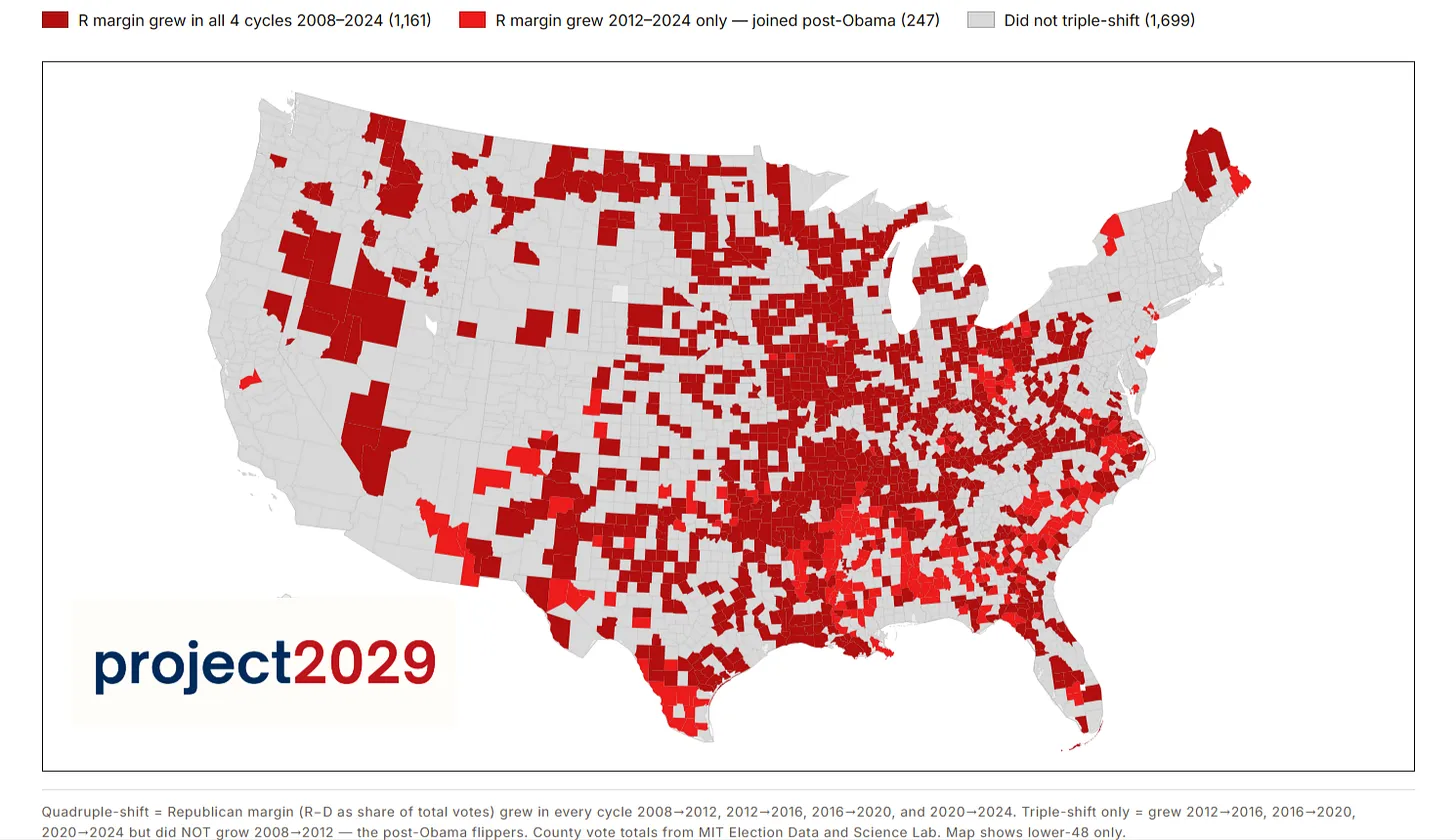
Using data sets from the Economic Innovation Group’s Distressed Communities Index and the MIT Election Lab, Project 2029 found that one-third of the counties in America have grown progressively more Republican in every presidential election from 2008 to 2024. Nearly half of all counties have voted more Republican in three out of the four.
Over the past four presidential elections – two won by Democrats, two won by Republicans – 1,161 of 3,107 counties saw the Republican margin grow in each one of those elections: more Republican in 2012 than in 2008, in 2016 than in 2012, in 2020 than in 2016, and in 2024 than in 2020. Another 247 joined the streak after 2012. (The New York Times detailed “triple-shifting” Republican counties in a 2025 analysis.)
By overlaying economic data, Project 2029’s analysis shows that these quadruple shifting counties are not a random set of places. Nearly 60 percent of these counties are in the most economically distressed 40 percent of America, and only 6 percent are in the top 20 percent economically.
Put simply: Half of America’s most economically hurting counties voted increasingly Republican in every single election since 2008.
Two-thirds of distressed counties shifted Republican in three consecutive elections; nine-tenths shifted in 3-out-of-4 contests. (The Distressed Communities Index measures factors like economic inequality, employment, business success, education and poverty.)
Among the bottom 20 percent of most economically distressed counties, 71 percent voted increasingly Republican three consecutive presidential elections in a row. For those in the fourth quintile, it was 60 percent. (In the most prosperous 20 percent of counties, only 14 percent showed the same kind of Republican shift).
What has happened in American politics is something deeper than Democrats going on too much about pronouns or not going on enough podcasts. It is deeper than Joe Biden’s age or Kamala Harris’ laugh. It is deeper too than transitory issues of inflation or the affordability of a carton of eggs or a gallon of gas.
Across lines of race and geography, Americans no longer believe either party offers them a path to a better future.
A recent survey showed that about two-thirds of Americans agree with the statement “society is broken.”
In a Wall Street Journal/NORC poll last year, 72 percent of Americans rated their present financial situation comfortable or adequate – even if things weren’t easy, they were at least getting by. But just a quarter believe they or their family have a good chance of improving their standard of living. Almost eighty percent have no confidence that life for their children’s generation will be better than it has been for them. Nearly half are not confident that children in their community “are getting the education they need to achieve financial stability.”
When it comes to the basic promise of the American Dream, the idea “that if you work hard, you’ll get ahead,” 69 percent believe it no longer holds true or perhaps never did. Instead, they see a different America: 55 percent agreed that “The economic and political systems in the country are stacked against people like me.”
For half a century, Gallup has asked about Americans’ satisfaction with the way things are going in the U.S. From the early 1980s to the mid-2000s, the percentage satisfied were generally above 40 percent, often above 50 percent, sometimes cracking 70 percent. In the past twenty years, the percentage satisfied has broken past 40 percent only once.
Donald Trump and the Republicans have confronted this American political landscape with an agenda of division and scapegoating. The Democrats will never be the party of hate and division; instead, their only option is to once again be the Party of Hope.
To become that once again will require more than rhetoric and empty promises. It requires an agenda that breaks with the failed policies of the past, offers real reform, and credibly inspires faith in Americans that their and their families’ tomorrows can be better. Contributing to that agenda is the work of Project 2029.