
How Does Change Happen?
I saw first-hand how progress becomes real - and it shapes Project 2029’s theory of change
by Andrei Cherny, Project 2029 Chair
How does change happen?
It’s a question we think about often at Project 2029.
Some of the ways that transformations take place in America’s government are very visible: ballots are cast, marches are held, filibusters are broken, bills are signed.
But some parts of how those shifts occur, sometimes the parts before the public drama, are more quiet. Consider some examples of change, for good or ill:
- In the 1920s, a small group of policy thinkers in foundations and universities wrestled with – and argued amongst themselves over – ideas for how government should adapt to help workers in the industrial age. They were ignored most of the time and ridiculed the rest. But a decade or so later, their ideas became Social Security, unemployment insurance, and the minimum wage.
- In a revolution in government that did harm, an economist named Arthur Laffer drew a graph on a dinner napkin at a Washington restaurant in 1974 and showed it to two of President Gerald Ford’s young aides, Dick Cheney and Don Rumsfeld. Most Republicans then didn’t buy the concept of supply-side tax cuts, but first a junior Congressman named Jack Kemp and then a candidate for President named Ronald Reagan embraced what became trickle-down economics.
I played a small role in one of those types of stories and it informs how we work at Project 2029 and our theory of how change happens.
Twenty years ago, I co-founded Democracy, a liberal public policy journal, because I believed Democrats needed new thinking to meet the times. We reached out to the smartest and most innovative thinkers we knew to see if they had ideas to put forward. One of them was a little-known law professor at Harvard named Elizabeth Warren. She told us she had been noodling on an idea: a Financial Product Safety Commission that would regulate mortgages and credit cards as the Consumer Product Safety Commission regulates toasters and light bulbs.
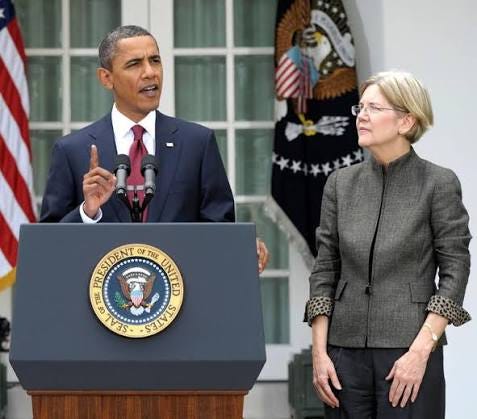
In 2007, we published Warren’s idea. Working with her, we brought the idea to reporters and public officials. Hillary Clinton and John Edwards ran on the idea in the 2008 presidential primary campaign. Barack Obama embraced it as the Democratic nominee. It took President Obama’s election, the Great Recession and 2009 financial crisis, and a battle against the largest army of lobbyists ever assembled to pass the Dodd-Frank Act, but in 2010 the Consumer Financial Protection Bureau became a reality.
Bringing change from idea to law is like a relay race – candidates, voters, elected officials, organizers, engaged citizens all run their leg to reach the finish line. At Project 2029, we believe our leg is developing the next set of breakthrough ideas that upset the stale debates and conventional thinking trapping so much of our political conversation. That’s what we’ve been doing thus far. Potential presidential candidates and the press have been paying attention – and there is much, much more to come as we get ready to release the full Project 2029 plan next year.
The 2028 “ideas primary” starts in just a couple of weeks. America’s future depends on us getting it right.